United Kingdom and Ireland Chapter


>

Meeting Notice - Annual Symposium and AGM

The Chapter is pleased to announce that registration is now open for the annual Symposium and AGM, to be held on 19th March, at the Institute of Physics in London.

Join us to connect with key figures in the UK display industry, ranging from leaders in cutting-edge academic research to developers of components, materials, and system integrators. Our confirmed speakers include top professionals from:

Merck, Forvia, Brightview Technolgies, TruLife Optics, Pixel-Flo, University of Surrey, Ansys, Counterpoint Research, Intel  with an opening address by SID’s President, John Kymissis

Register here


---------------------------------------------------------------------------------

Ben Sturgeon Award

Rank Prize Fund
Dr. Anthony Lowe Award


***Link to SID's Webinar archive - note webinars are only published with speaker's permission.***

Past Meetings:

"Perovskite colour converters for AR/VR microdisplays" - Bernard Wenger, 19th February 2026

"Air based lightguides for LED Backlights" - James Gourlay, 17th December 2025

"Microfluidic visual communication systems" - Michel Delmas, 10th September 2025

"Displayweek Business Conference Highlights" - Bob Raikes, 10th July 2025

"Bringing OTFT technology into mass production for flexible EPD and beyond" - Dr Paul Cain, 29th April 2025

"Direct Atomic Layer Processing (DALP®), a novel approach to micro- and nanoscale device manufacturing" - Dr Benjamin Borrie, 24th April 2024

"The Challenge of Realizing Low Power Logic from Thin Film Semiconductors" - Prof Andrew Flewitt, 12th Nov 2024

"EuroDisplay in Review" - Dr Adrian Travis, 23rd Oct 2024

"AR/VR Displays: Technology Trends and Market Outlook" - Guillaume Chansin, 12th Sept 2024

"Gamut Rings, and why to stop using Chromaticity" - Dr Euan Smith, 23rd July 2024 

"Reflections on Displayweek" Sam Phenix and Ed Buckley, 27th June 2024

UK/IRL in-person meeting and AGM, 14th March 2024

"Holographic displays for AR" - Dr Ed Buckley, 13th February 2024

"Achieving Energy Efficiency in Red microLEDs for the next generation of microLED Displays" - Caroline O'Brien, Webinar, 16th January 2024

"Building the future of Semiconductor Lighting with Surface Emitting SLEDs" - Dr Juan Morales, Webinar, 6th December 2023

"Emissive displays using Organic Thin-Film Transistor Technology" - Dr Simon Ogier, Webinar, 7th November 2023

"Development of the first wireless dynamic focus liquid crystal contact lenses" - Dr James Bailey, Webinar, 25th October 2023

"Can we tame the light waves?" - Prof Mohsen Rahmani, Webinar, 19th September 2023

"Waveguides for Augmented Reality Displays" - Dr Andreas Georgiou, Webinar, 12th July 2023

"Flexible LC optics and displays for curved and biaxially formed active surfaces" - Dr Paul Cain, FlexEnable, Webinar, 28th June 2023

"Perovskites for In-Pixel Colour Conversion" - Dr Bernard Wenger, Helio Display Materials, Webinar, 12th April 2023

2022 SID session at ITC 2022, University of Surrey, Guildford, 15th Sept 2022

2020 SID session at InnoLAE 2020, Wellcome Genome Camplus, Cambridge, 21st Jan 2020

"Emerging technologies for displays" - Programme

2019 AGM and 1-Day Technical Meeting, CSA Catapult Innovation Centre, Newport, Wednesday 20th November 2019,

"Compound Semiconductors for Display Applicaitons" - Programme

2018 AGM and Evening Technical Meeting, UCL, 28th Nov 2018.

"Integrated Photonics and Electronics for Displays" - Programme

2018 LCD 50th Anniversary Meeting, Royal Academy of Engineering, 7th June 2018

Programme   Report   Review Article in "Liquid Crystals Today"

2017 1-day Technical Meeting, Flexenable, 24th October 2017

"Emerging Display Technologies" - Programme

2017 - Free Technical Meeting, BBC R+D, 27th Feb 2017

"HDR and the Future of TV" - Programme

UK and Ireland Chapter Committee List

Chair     

Prof Tim Wilkinson

tdw13@cam.ac.uk

Vice Chair


Secretary

Dr Peter Wyatt

peter.wyatt@merckgroup.com

Treasurer

Paul Lacey

laceypaul@aol.com

Communications Officer

Tim Large

tlarge@outlook.com

Membership Secretary

Jiaqi Liu

jl2186@cam.ac.uk


The AGM of the UK Chapter was held along with a one day in-person technical meeting at the Institute of Physics, London on March 19th 2026. The following officers were elected for the next year.

  • Chair: Timothy Large​
  • Vice Chair: Ed Buckley​
  • Secretary: Peter Wyatt​
  • Treasurer: Paul Lacey ​
  • Membership Secretary: Eva Bestelink 
  • Communications: Bob Raikes
The Chapter was reported as showing a loss for 2025/26 because of the need to pay for the meeting in advance. 
 
Prof. Radu Sporea of the University of Guildford was presented with the Ben Sturgeon Award for his work on new transistor types and he gave a talk about that technology.
 

The SID’s UK Chapter held its Annual General Meeting and In-Person Technical meeting at the Institute of Physics in London on March 19th. As well as the AGM business, there were eleven technical talks during the day.

Photos and names of the speakers from the event

SID Has Always been Involved in the Long History of MicroLED

Eva Longoria introduced Prof John Kymissis of Columbia University in the US. He is President of the SID and he spoke about microLEDs. His presence at the UK chapter meeting was much appreciated by delegates. He looked at the development of microLEDs and their history, highlighting the involvement of SID members.

LEDs really took off in the early 1960s and microLEDs were of interest from the start. Of all devices that scientists have developed, LEDs have the highest luminance and highest efficiency (>50%), they are emissive and have great colour. They also have a long lifetime.

When LEDs are used in large format displays they have just a 0.1% to 1% fill factor, so the display substrate has a big influence on the quality, but the display can still achieve high brightness. A challenge has been to make a microLED that can overpower the 2,000 nits of outdoor ambient light, which means very high luminance even with relatively low contrast.

Looking back in history, HP used LEDs in its calculators from 1968 and they made watches with LEDs in 1977. The segmented LED displays were referenced in the HP Journal Vol 20 Number 6 in July 1969.

At the Tsukuba Expo in 1985, Sony showed a Jumbotron ultra large (2000") display using CRTs and this ignited interested in extremely large displays and this application has now completely migrated to use LEDs. In small size applications, the first LED microdisplay was probably from Reflection Technology. It swept a line image to create a display and was adopted by Nintendo 1995 in its ‘VirtualBoy’ headset display, although that product was not a success.

Pre-2010 there was a lot of interest at the research level, but at CES 2012, Sony showed its Crystal TV. It was very secretive about the technology although details were eventually published in the JSID in June 2021, Kymissis said.

There are two distinct types of LED microdisplays - larger direct view displays and microdisplays based on silicon IC substrates. Both options need active matrix driving, but the engineering challenges are quite different.

Are there new issues in commercialising microLEDs in consumer applications such as TV, he asked? He showed the predictions from the HP journal referenced from the late '60s, which highlighted the cost and numbers of LEDs needed (and that was in the days of Standard Definition TV so based on just 0.25 million LEDs. Today, you would need 100 times that many for a 4K TV - editor). The challenges haven't really changed.

UCLA saw the founding of the SID 50 years ago and there is a calculator from HP on the university site where the founding is commemorated. The engineers that designed the LED, Howard C. Borden and Gerald P. Pighini were both members of the then newly formed SID, so SID has been involved with LEDs from the start.

Automotive is Developing as an Application

Guillaume Chansin is from Counterpoint Research and he spoke about automotive displays, an applicartion which he is now covering as an analyst.

Digital cockpits are getting more complex with more and bigger displays and with functions going well beyond the infotainment system.

Among the main panel makers, only Samsung is making consistent profits and so others are looking for higher margins in areas such as automotive. The Chinese dominate the LCD supply industry with Taiwan struggling to stay involved. Another business trend is that panel makers are moving up the value chain by acquisitions (e.g. Samsung of Harman). AUO, Innolux and TCL/CSOT have followed this trend and moved into the automotive segment. TCL is reported to be setting up a JV with Brilliance to support the Chinese automotive market.

Revenues in automotive are increasing by 11% between 2024/25 when other markets are flat or growing more slowly, which increases the attractiveness of the application.

Chansin described the different configurations as the market moves from analogue instrument clusters to, at the other end, Pillar to Pillar (P2P) displays across the whole of the dashboard. China is the best region for automotive market growth and in technology market share terms, LCD capturess around 99% because of the maturity of the technology. Larger sizes at over 10” are increasing their share, with a lot of push from Chinese auto makers.

10”-15” is a ‘sweet spot’ in terms of size and the share of the market in that size range may stabilise going forward. That is an efficient size for LCD makers to produce. There is also a move to reduce the reliance on touch screens through safety regulations and in many regions the use of physical buttons is being mandated. The display can also block the space for driver sensors and the trend from now could be on how to develop more functions for the display, including sensors, to exploit its position in the cockpit.

LCD and miniLED LCD panels dominate the market with OLED improving in share because of the use of tandem stacks, and makers are working on microLED, but this is still in the development phase. There have been many demonstrations at Display Week.

Chansin looked at recent designs, but also said that there are many ideas for new form factors, although they have not been adopted yet.

A number of panel makers are looking at HUDs using microLEDs, but there are already a number of technology solutions available. Emissive technology may enable higher contrast than current technologies. In China, Chanson explained, it is normal to get a HUD in a new car (around 50%) while it’s still an extra cost option in other markets.

His main message was that China is very important for the market and there are many differences to other markets.

Challenges in HUDs

Flurin Herron is from Ansys, part of Synopsys and he talked about some of the challenges in Head-up display (HUD) technology. He explained the basic topology of HUDs, which have been developed from use in the aviation industry. There is usually a light source, a reflector (windshield) and a magnifying lens. Ansys makes software for optical modelling which can be used to optimise the design of systems.

The windshield is a standard component for auto makers and during the development process, the iterations of the HUD design with the windshield makers typically took a long time, so the firm has developed its software products to speed up the optimisation process.

Zemas OpticStudio is a multi-decade established optical tool. A second product is Xemax, which brings in physical parameters to the process. 

Herren went through the details of the way that the software is used to speed up the process. Of course, these days there is the use of AI for prediction modelling. The technology can also be used to check actual results compared to predictions. 

An interesting further step is the way that you can take into account aspects such as reflection, glare and even the TIR between the layers inside the windshield. The software can also be used to understand factors such as residual manufacturing stress in the windshield that can impact the optics. Defrost wires can also be taken into account.

The use of automated processes eases the challenges of multi-discipline development which are the norm these days. 

Brightview Makes Patterned Microstructure Film

Mike Murphy is from Brightview Technologies based in Raleigh NC in the USA. The firm makes microstructured film technology for optical transformation. They are not diffusers, and light passes through the films completely. Applications include microlens-arrays with features smaller than a human hair. Applications include displays, lighting, sensing, AR/VR and automotive as well as 3D sensing.

The firm’s special technology is in creating the production systems using ‘greyscale photolithography’ and the films are made on a roll-to-roll basis. One of the main applications in displays is in LCDs and so power consumption is always a challenge. The firm’s special technology allows the manufacture gain enhancement films. This is especially important in mobile devices such as notebooks. The notebook PC market is under pressure because of the increasing use of power for applications such as AI, so although the overall market is not growing, there is an increasing demand for better efficiency.

The firm has a range of solutions for different customers and applications and there are often multiple differentiated solutions, even in a single market such as ‘edge-lit notebook PCs’. Backlit LCDs are also a significant market for automotive and other applications.

The firm’s special technology can be used to create zonal MLAs that can be highly optimised with different structures in different parts of the film, for example around the LEDs in miniLED backlights. The film can also be used for colour correction and is used in one application for fixing the blue edge distortion that can come from blue backlights. The technology is used in a recently launched high end monitor from an un-named computer brand. 

In smart glasses, especially for Augmented Reality, there is also a great need for optical efficiency and there are several places in the optical path that the films can be used. 3D sensing for authentication is a developing market. Palm recognition is a growth area because of privacy concerns over facial recognition.

Murphy then looked at the automotive market. He highlighted that India is a smaller market, but is growing faster even than China. Brightview is working in HUDs and also has experience in military aviation.

Forvia Exploits Air-based Light Guides

James Gourlay is from Forvia which is a tier 1 supplier to the automotive market, and he spoke about his group’s light manipulation technology which is used in that application. After his company introduction, he highlighted the use of lighting and displays in automotive cockpits and on the outsides of vehicles.

Sustainability is a big topic in the automotive industry and Forvia has ambitious targets in that area. 3M invented prism films in air-based light guides and Gourlay’s group has been working on this technology. The use of air-based light guides reduces the amount of material, helping weight, bulk and cost compared to solid light guides.

At the event, the firm was showing a sample backlight using an air light guide. Usually prism films are homogenous, but like Brightview, the firm has its own prism patterning technology to allow detailed and varied patterning in different parts of the film.

Gourlay explained how his firm’s technology can be used to reduce the number of light source zones (I.e. LEDs), without reducing the number of zones that are apparent to the user. That helps to reduce cost and bulk. 

Usually, in miniLED backlights (BLU), the thickness of the system depends on the LED pitch, but the films can be used to keep the complete BLUs thin while limiting the number of LEDs. Forvia has tools for optimisation and design.

Grid Mura Index is a metric for the ‘dottiness’ of miniLED backlights and is used by the company to characterise different backlight designs.
Intel Continues to Optimise Video Processing using AI

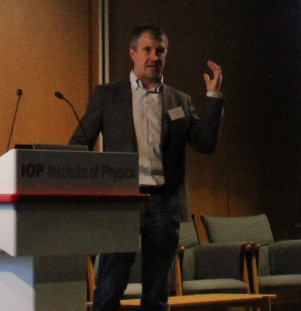
Ben Cope of Intel asked how AI can be used to improve video processing. 

Video processing and compression technology has not really changed in terms of the key processes and steps in several decades although clever things happen within the various processes, Cope explained. Intel introduced its latest Core Ultra Series 3 at CES this year, and this will bring a lot additional compute power for AI. 

Looking at video scaling, the challenge is to deal with visible edges. Basically, scaling averages the value of different pixels. Cope showed images from an Intel partner company, SmallPixels, that had been scaled to get crisper edges using the latest processor. The next generation of codecs is likely to include some aspects of AI although there are also companies starting again using an AI approach.
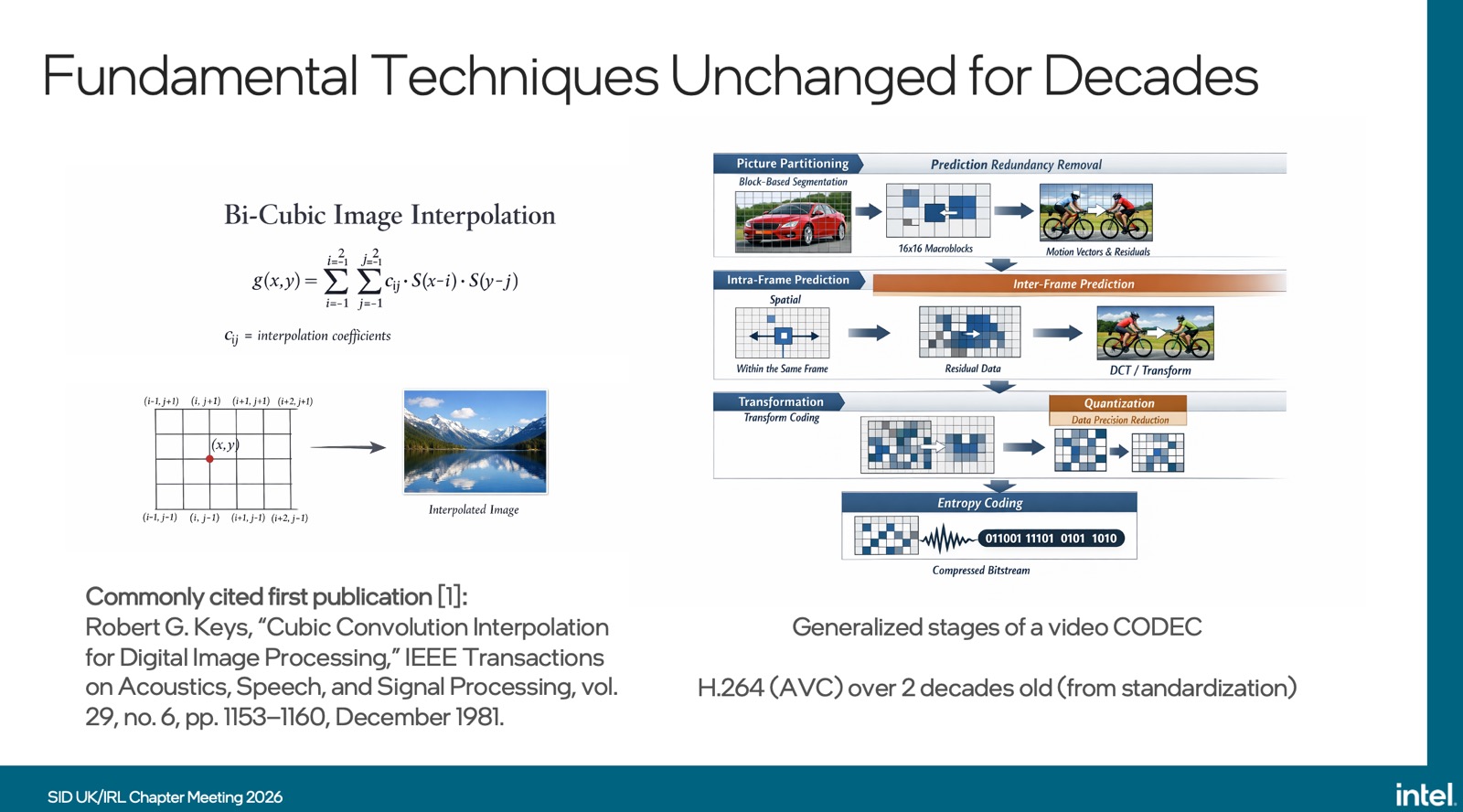
AI is being used already in video processing including, for example, upscaling of existing SD content to HD or even UltraHD. It was used in a demonstration of 8K streaming by Intel in association with the 8K Association during the last Olympics where AI was used to optimise the compression process. Cope highlighted during discussions that the 8K video was transmitted at an average of 20Mbps using the VVC codec developed by Spin Digital GmbH.

In practical applications, such as the use of video in tracking retail transactions, better AI-based scaling can help to improve object detection. Cope showed the results from a test comparing AI processed and non-processed identification at lower bit rates.

The full power in the new systems comes from a combination of CPUs, GPUs and NPUs to achieve high levels of performance. Which is best depends on the balance of need for low latency, power or power consumption.

EuroDisplay, AGM and Ben Sturgeon Intermission

Sam Phenix then gave details of the EuroDisplay conference which will take place from 22nd to 24th of September in Dublin, Ireland. Special rates for the conference hotel are currently available. 

Tim Large conducted the formal business of the AGM for the UK chapter including the election of a new committee, which he will chair.

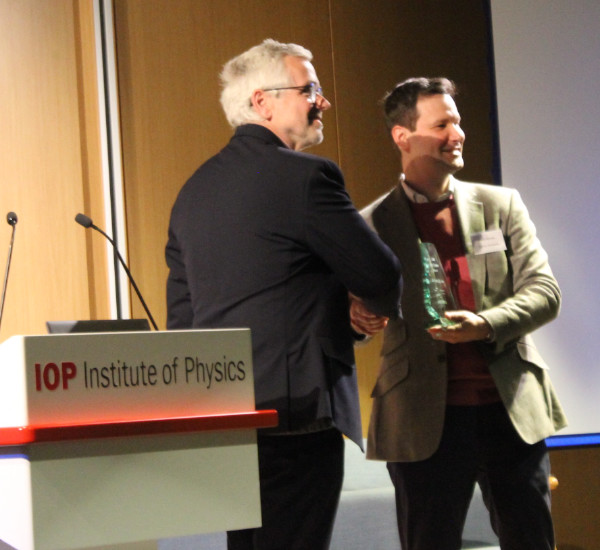
Prof Radu A. Sporea of Surrey University was awarded the Ben Sturgeon prize for his work on new transistor types used in displays and he explained the technology. The prize is awarded to young researchers in the display field which the UK chapter defines as work carried out before the age of 40.
New Transistors Offer Key Advantages vs LTPO

Sporea’s key work was on the source-gated transistor (SGT), the idea for which was first in a published paper in 2003 (IEEE Electron Device Letters, Vol 24. No 6, June 2003 ‘Source-gated Thin-Film Transistors’). The concept is to add a layer that controls the current in a Field Effect Transistor (FET) in the source rather than at the drain. The layer appears to reduce the efficiency of the transistor but allows you to do different things. 
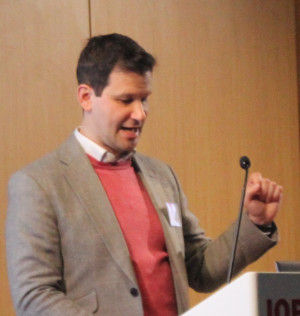
He started by saying that his talk summarised around eight years of collaborative work, not least with Eva Bestelink of the UK chapter.

The Multimodal transistor (MMT) is a development of the SGT with two distinct control areas, one for current and one for the timing of current flow. One gate (CG1) exclusively controls the injection process while CG2 controls the conductivity of the channel. It’s a series process. 

The devices can be made with all kinds of materials including polysilicon and IGZO and there are relatively simple design rules. Whatever is available in the technology can be exploited to support the CG2 barrier. You need a thin high K semiconductor and a relatively thick lower K dielectric. This allows the output curves to saturate at significantly lower voltage.

Using polysilicon, you can create something that is very close to an ideal current source. That source could be used to drive an emissive pixel, but can also be used in an amplifier configuration.

Sporea looked at the operation of simple two LTPS SGT-based devices which allow very high levels of gain. This can make the transistors very useful for sensor applications.

He then looked at work on organic source-gated phototransistors and he said that the characteristics are more consistent using a CT transistor. He described a three transistor configuration that can be used to create a very sensitive temperature sensor. The temperature sensitivity by manipulating the dimensions of the transistor and the performance is available at different common voltages so careful power supply is not needed.

The work on pixel drivers is at a relatively early stage but there are already significant advantages. Again, there is relatively less dependence on power supply conditions. 

The MMTs have significantly better performance in IT and possibly smartphone displays. 

In smartphones, in particular, LTPO has been adopted to allow low refresh rates and improved power efficiency. As he explained, Oxides have very good off-current, but LTPS has very good on-current, which is why the combination is used. Source-gated transistors can offer an alternative.

In principle, LTPS only 1Hz devices are possible using contact controlled transistors. This could give significant production advantages over LTPO.

With this kind of contact controlled transistor there is a trade off of speed and current density for gain, stability and uniformity. Although there may appear to be shortcomings, these can be bypassed by elegant design solutions.

Multimodal transistor is a more refined version than the SGT with two control gates (CG). CG1 controls current flowing through the device, but CG2 controls the timing of that current. 

Organic transistors can be used and have a very low off current. Sporea likened the CGs to a hose system, where the tap controls the level of water available, while a sprinkler control dictates when the water will flow. He described the different response curves of CG1 and CG2 and shows the independence of the two gates.

In display applications, Sporea’s group have developed a 7T2C (6T1M2C) pixel driver which can offer simultaneous pulse amplitude (PAM) and width (PWM) modulation and that can be an advantage in many displays using LTPS, IGZO or even amorphous silicon. 
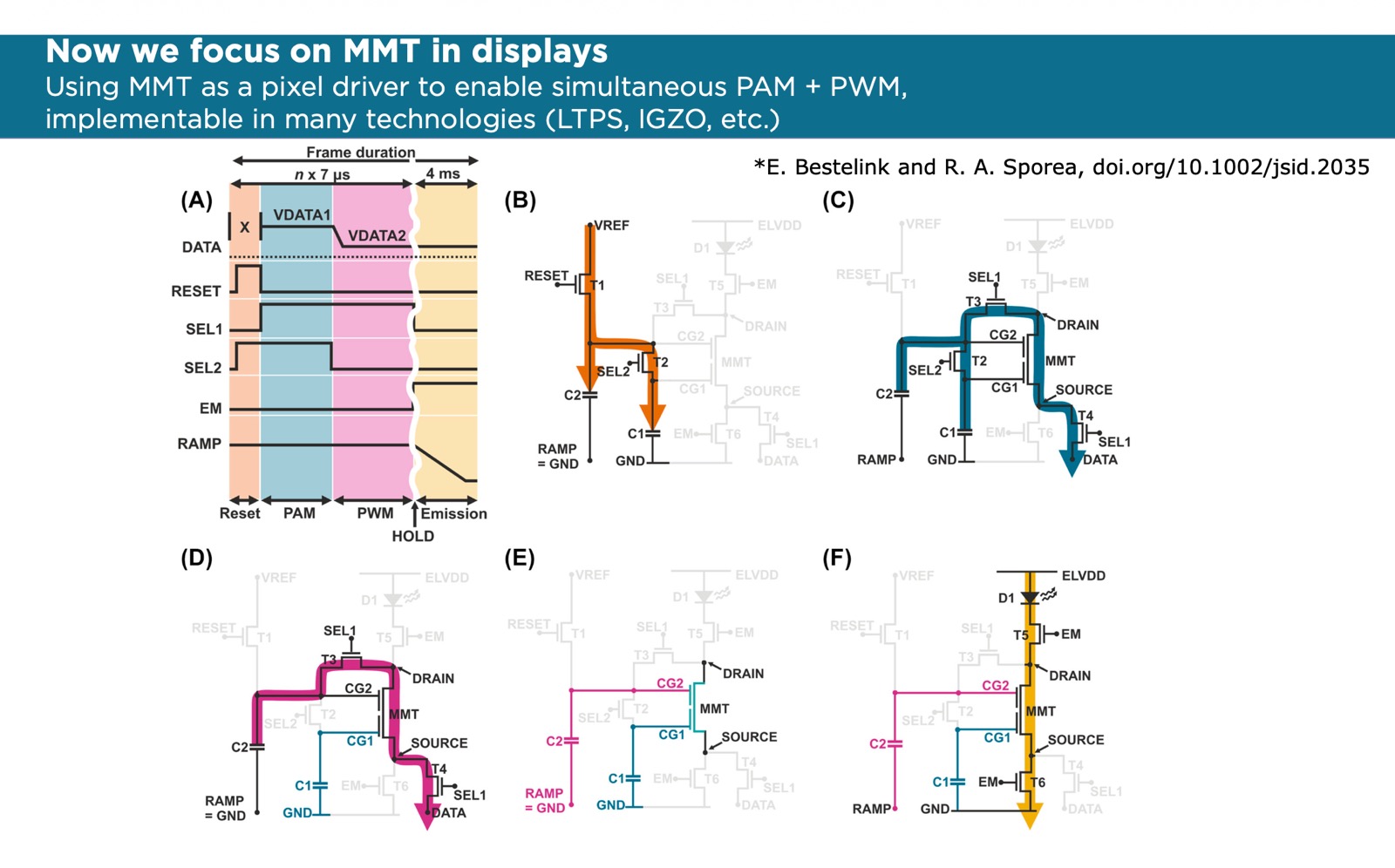
Quoting data from Hendy Consulting, Sporea highlighted the big saving in capex moving from LTPO to LTPS. This could be as much as $724 million for a G6 fab with 30K substrates/month throughput.

The technology also has applications in sensors and in AI applications.

Merck is Using Reactive Mesogens for Optical Films 
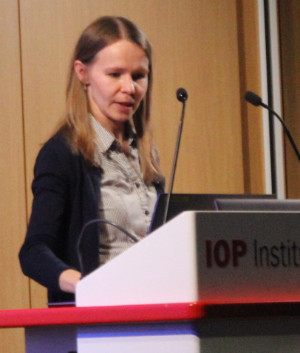
Nina Podoliak is from Southampton where she is working for Merck Performance Materials in the area of reactive mesogens (RMs) for optical film especially for waveguides in augmented reality (AR) headsets. 

AR development really started in 1968 or so, but the key moment was the arrival of Google Glass in 2014. Podoliak covered the differences between AR and VR. You need different optical elements for each of these and she went through the challenges, of which there are many.

For AR glasses, the image needs to be generated, coupled to the optics then output to the user’s eye. To get some scaling, you usually need more optics. Podoliak highlighted nine key challenges including cost. 

She looked at the basic principles of operation from image generation, coupling to the waveguide and the outcoupling. The waveguide also be thin and transparent. Goals for the system include wide field of view (FOV), large eye box, high efficiency, good colour and low levels of stray light.

There are two kinds of main waveguides used. Geometric (based on embedded mirrors or prisms) optics are used by Meta. The other kind is the diffractive type and there are multiple different types. There are four main diffraction types 

  • Surface relief gratings
  • Volume holographic gratings
  • Metamaterial gratings
  • Polarization volume holograms (PVH)

Podoliak went through the pros and cons of each approach.

The group is working on PVH solutions based on the use of reactive mesogens which are polymerizable LC materials. In these materials they can be aligned as liquids and after the LC phase can be turned into a durable plastic film which maintains the alignment. UV light is typically used. The materials can be anisotropic with controllable properties and are already used in compensation films, for example.

One of the uses for the films is the creation of Pancharatnam-Berry (PB) gratings which have high diffraction efficiency. RMs can be used to make multi-layer or multi-slant devices. Photo-alignment can be used to create different alignments of the LC materials and additional layers can be simply added without intermediate processing. Different manufacture methods include slot die coating and ink-jet printing so fabrication is straightforward. 

There are two key control dimensions. You can control the pitch of the grating at the surface and you can also control the type of material used which can control the degree of chirality from chiral to non-chiral. These options allow a range of solutions based on dual axis grid.

Configurations can be made that split light into two circular polarised streams that will be emitted in different directions according to the PB pitch. The material type can control between the Raman-Nath and Bragg regimes. The technology can be used to make reflective or transmissive lenses and PVHs. 

Podoliak turned to a comparison of SRGs vs PVH devices. While SEGs are sensitive to linear polarisation, PVH respond to circular. With SRGs, it is hard to eliminate unwanted effects. PVHs can match the light chirality to the material chirality and you can achieve polarisation multiplexing for each eye using the chirality.

You can reduce eye glow (the stray light going away from the eye in AR glasses) by introducing slant in the outcoupling grating. In PVH, the grating automatically reduces eye glow whereas using SRGs, it is difficult to eliminate. 

PVHs can give higher incoupling efficiency also reducing second interaction loss. Podoliak went through the different processes at in- and outcoupling. 

Turning to broadband and uniformity, with SRGs there are usually trade-offs between efficiency and angular uniformity, so higher efficiency can be achieved, but at the cost of a smaller FOV. 

PVH can be engineered for better angular range and efficiency because of the possibility of multilayer, multislant gratings. There is more flexibility to achieve waveguide optimisation.

Podoliak explained that PVH not yet developed in industrialisation yet. Material can be photoaligned which is a mass production process. RMs can be deposited with inkjets and can then be polymerised.

Sky Working to Improve TV Efficiency

Alexandra Szemjonov presented details of her work at Sky on improving the energy performance of the TVs that her company supplies. Sky wants to see better efficiency for its consumers, but also better performance.

The group at Sky starts with material analysis and then moves to testing in the lab and comparison of material specifications against prototypes. The firm also uses and develops modelling for simulation. 

Szemionov’s group looked at the optical stack in the LCD TVs being sold and started with optimisation of factors in the materials used. The group looked at losses in the many different layers and she highlighted the multiple recycling opportunities for the light coming from the backlight. 

Diffuser plates can use particle-based scatter or also surface structure scattering. If it’s done well, you can use a lower density of particles than if the parameters are not optimised. This kind of optimisation can deliver 4% boost in the output on its own.

She explained the operation of the brightness Enhancement Films (BEFs) and stressed the importance of controlling the viewing angular distribution - it needs to be balanced over the viewing cone, not just improved for a viewer on axis. Materials with an improved refractive index can boost efficiency by 1%. 

Sometimes you can get much better brightness because of system level changes rather than materials. The boost in efficiency can be up to 24% using commercially available films. It is useful to have modelling to allow the theoretical use of alternate materials and designs.

Uniformity and brightness are key parameters for the viewing experience. Sky is using software previously described in the morning by Ansys. The software can be useful to understand parameter sensitivities as well as in developing optimal systems. 

More LEDs and zones in direct backlights add to cost and complexity. Low LED pitch and larger diffuser gaps give the best results from a cost point of view. However, her team has been able to optimise solutions to give good performance even with a 25mm pitch between LEDs in each direction and a diffuser gap of 7mm. This keeps the set slimmer than with a large air gap.

Holographic Optics Have Value in AR

The final session of the afternoon was opened by Helen Smith of Trulife Optics TLO, an R&D company based in London with 40 people. The firm is working on, among other AR-related topics, holographic films for AR applications. The firm undertakes modelling and experimentation but also some prototyping and has recently partnered with Nitto Denko for production.

When you start to use a diffraction grating in optics, the diffraction is different and has different bandwidth according to the design. However, Volume Holography (VH) film is designed for a specific wavelength to ensure consistent performance. Each layer of film is transparent to other frequencies, so the layers can be stacked for wider bandwidth support. You can also add other optical functions. The range of feature sizes is typically 5-50 microns and there is very little loss in transparency which allows high efficiency.

Input and output light streams can be combined - so an image of the eye can be taken to a camera while the hologram is acting as an output device for an AR-related display. 

In AR glasses, two holograms are typically used - one for in-coupling, one for outcoupling. The technology typically supports a large eyebox, which is an advantage.

Optical design can be very tricky with curved waveguides - the light typically loses its angular encoding although this can depend on pupil position. 

TLO instead uses a bespoke correction function to maintain the TIR as the light moves through the waveguide and maintains the correct angular encoding. When modelling and developing solutions, the firm uses flat optics initially and then adjusts for the curve later.

Nitto Denko is working on mass production of the films with TLO.

Smith said that TLO is working on ‘all day’ AR glasses and these need to be prescription-ready and use the existing ophthalmic industry. However, the limit for ophthalmic glasses is at around 32gms and AR is not yet at that level. 

For usefulness, performance needs to be at 10lp/degree with 30% contrast but colour uniformity Is also a challenge in AR. For diffractive waveguides, a challenge is the tight tolerance on the dimensions of the waveguide. You need high refractive index material to make waveguides with SRG, but holographic devices are better.

Holographic devices can also be used for VR pancake lens and also for eye capture, she concluded.

Pixel-Flo Looking to Advance Fluidic Self-Assemble for MicroLEDs

Rick Smith is from Pixel-Flo, a spin-out from Sheffield University in the UK in 2025 and which launched at Display Week last year. The company is developing systems for the mass transfer of microLEDs using fluidic self-assembly. Smith started by acknowledging that for MicroLED, there are big benefits but to some extent the technology is on the ‘hype curve’.

Mass transfer remains a bottleneck in reaching mass production of lower cost microLEDs and perhaps starting to challenge other technologies such as OLED. Further, the larger substrates typically needed to start to compete with LCD or OLED depend on larger substrates and increasing size usually makes mass transfer harder.

To get around this, Pixel-Flo is working on a fluidic self-assembly process that exploits the well-established process of slot-die deposition. Basically conventional photolithography is used to create ‘pits’ on the surface of the target substrate, then the microLEDs are transferred in the liquid with the trailing meniscus of the liquid particularly important. The company has demonstrated the deposition of 4 micron LED dies at a 25 micron pitch,

One of the advantages of the system is that the process can use all the dies from a wafer, even from around the edge, rather than needing to pick rectangular areas. 

Smith went through the generations of fluidic self-assembly and characterised the three generations so far as:

  • The first generation (Alien Technology circa 1999? - editor) could get the dies into the pits, but couldn’t keep them there.
  • The second generation (eLux circa 2016 [and bought by Sharp in 2017 before a spin-out again]? - editor) could trap the dies, but needed immersion of the panel into liquid which was a barrier from the process point of view.

Smith believes that his is the first technology that can make self-assembly a workable option. In questions he said that the system could be used to deposit a single RGB fluid or could be used in sequential steps to deposit different colours.

SID 50th Anniversary

As part of the UK & Ireland Chapter's response to the 50th Anniversary of the founding of the Society for Information Display, two members have written articles:

UK Contributions to LCD Technology

We are indebted to Professor Peter Raynes, a pivotal figure in the development of LCD technology in the UK for his recollections of key moments of discovery.


Notes on the Development of the UKI Chapter

We also thank Dr John Mansell, an active committee member of the UK & Ireland chapter for his account of its founding.

We are pleased to announce that the winner of the 2025 SID Ben Sturgeon award is Dr Radu Sporea. 

Dr Sporea is Associate Professor in Semiconductor Devices at the University of Surrey, and holds an EPSRC Early Career Fellowship (2021-2026). He was RAEng Research Fellow (2011-2016), EPSRC PhD+ Fellow (2010-2011) and PhD researcher (2006 – 2010). Radu studied Computer Systems Engineering at “Politehnica” University, Bucharest, and worked as Design Engineer for Catalyst Semiconductor Romania on ultra-low-power CMOS analog circuits. Radu was named EPSRC Rising Star in 2014 and received the I K Brunel Award for Engineering in 2015, the Vice Chancellor’s award for Early Career Teaching in 2017 and the Tony Jeans Inspirational Teaching distinction in 2018. In 2021, he was a finalist for Innovator of the Year prize at Surrey. His research focuses on advanced thin-film transistors for improved manufacturability, large area sensors and sensor arrays for smart environments, and paper-based electronics and physical-digital interaction. He was chair of the IEEE EDS UK and Ireland chapter between 2022 and 2024.

SID UK and Ireland Chapter 2025 meeting and AGM

Tuesday March 18th

SID UK & Ireland hosted an in-person one day meeting on novel display technologies and display applications.

The meeting was at the Institute of Physics in London, close to Kings Cross St Pancras Station.  The meeting created a perfect opportunity to network in person with leaders in the field.

Speakers were: Intel, Counterpoint Research, Envisics, Microsoft, SeeCubic, Rain Technology, VividQ, Brightview Technologies, Reality Optics, Helio Display Materials, Ansys and Nanoco.

A video record of the event can be found here.  Thanks to Dominic Murphy for the video footage (dominic@dofilm.org +44 7715 639066).


Not a member?  Please consider joining SID.
Questions? Contact: UKI-SID@sid.org 

Get the latest display news and updates
straight through your email